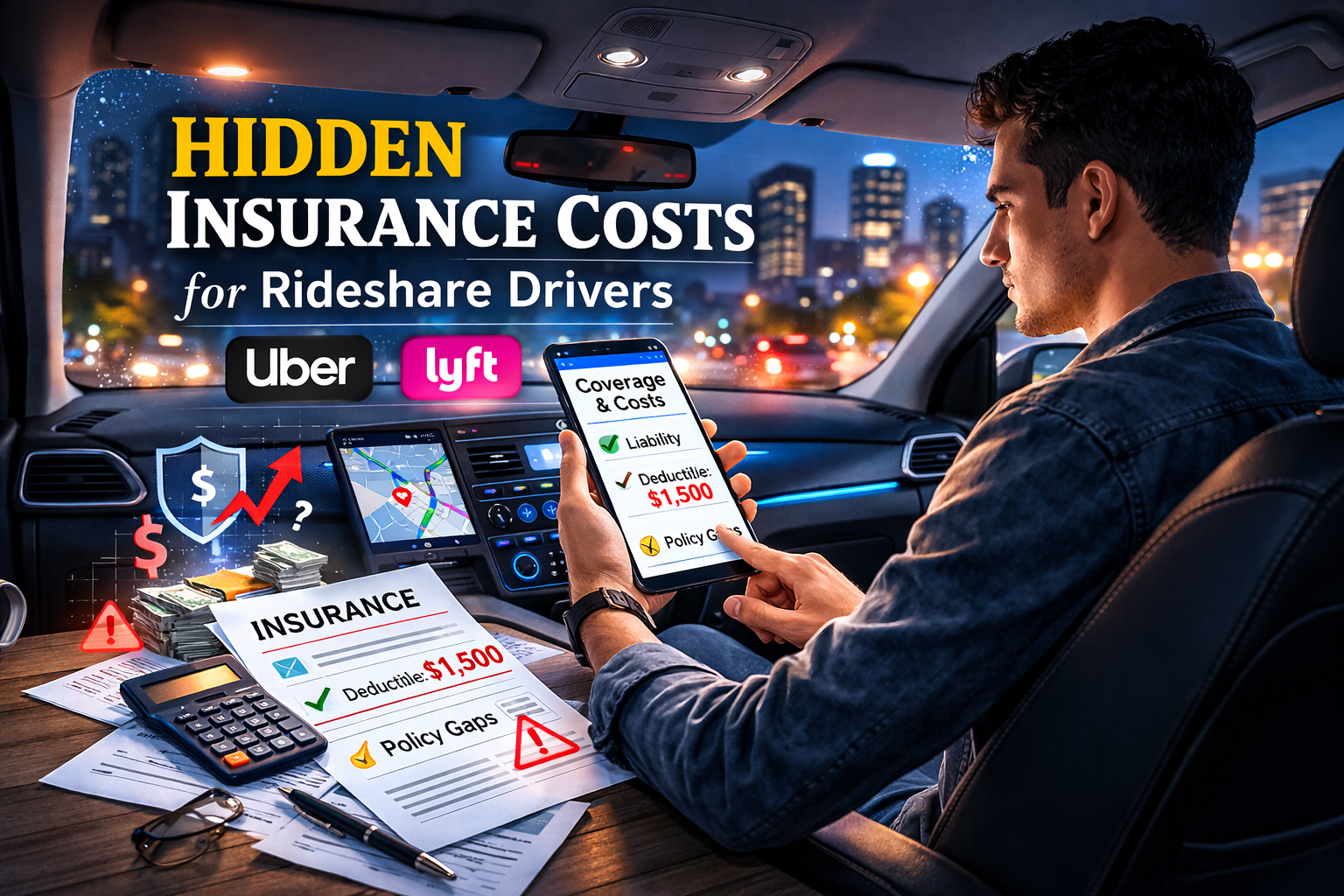
Rideshare Insurance for Uber & Lyft Drivers: Do You Need It?
If you drive for Uber, Lyft, DoorDash, Instacart, or any other gig platform, the single most important question you can answer about your financial safety is not “how much do I earn per hour?” It is “what actually happens if I get into an accident while I am logged in?” Most new drivers assume that the platform’s insurance will handle everything, and most experienced drivers eventually learn that this assumption is dangerously incomplete. The gap between what a personal auto policy covers and what a rideshare or delivery app requires you to do is real, it is common, and it can put your savings, your car, and even your home at risk.
This guide walks through the full picture in plain language: why ordinary car insurance was never designed for gig work, how the three-phase coverage timeline works, what a rideshare endorsement actually does, how commercial coverage differs, and how to verify your own situation before you accept your next trip request. Along the way you will find worked examples with illustrative numbers so you can see how the logic plays out in practice. Those numbers are examples only — they are not quotes from any insurance company, and your real numbers will differ. If you are brand new to the topic, our overview in the basics section is a good companion to this article.
Why your personal auto policy was never built for gig driving
Personal auto insurance is priced around a simple assumption: you drive your car for your own purposes, and the risk you create is a personal risk. The moment you accept money to move people or goods, the risk changes character. You are now on the road more hours, in more unfamiliar areas, often under time pressure, and you are providing a service to a paying customer. Insurers price that differently because the exposure is genuinely different. This is not an insurer being difficult — it is the same logic that makes a commercial delivery van cost more to insure than a family sedan.
The “for a fee” and livery exclusions
The mechanism that creates the gap is usually a clause in your personal policy that excludes coverage when the vehicle is used to carry persons or property for a fee, or when it is used as a public or livery conveyance. “Livery” is an old word that simply means a vehicle hired out to carry passengers. Many personal policies contain language along these lines, and when a claim happens during a paid trip, the insurer can point to that exclusion and decline the claim. The exact wording varies by carrier and by state, which is precisely why you should read your own policy declarations and the exclusions page rather than trusting a general rule of thumb. For a deeper look at how these exclusions are written and interpreted, see our explainer in the laws section.
Why the exclusion catches so many drivers
Three things make this trap so easy to fall into. First, the exclusion often does not care about your intent — it cares about whether you were engaged in the paid activity at the time of the loss. Second, many drivers never tell their insurer they started gig driving, so the policy was never rated or endorsed for it, and the insurer has no idea the exposure changed. Third, the exclusion language can be broad enough to reach situations a driver would never describe as “carrying passengers for a fee,” such as waiting for a request with the app on. The result is a claim denial at exactly the moment you can least afford one, frequently followed by a non-renewal or a rate increase that follows you to your next policy.
What drivers usually misunderstand
The most common misunderstanding is the belief that “the app’s insurance covers me, so I am fine.” The rideshare company’s coverage is real but conditional, layered, and limited, and it is not a substitute for the personal coverage you already need. The second most common misunderstanding is thinking that a rideshare endorsement is the same thing as a commercial policy. They solve overlapping but different problems. The third is assuming that delivery driving works exactly like passenger driving — it often does not, and the differences can matter enormously at claim time. If cost is your main concern as you sort this out, our breakdown in the cost section will help you plan.
The three-phase coverage timeline, explained
The industry-standard way to think about gig-driving risk is a three-phase timeline defined by what the app is doing. This framework is widely used because it matches how claims are actually evaluated, and because it makes the shifting layers of coverage easy to see. The exact limits and conditions vary by company and by state, so treat the structure as a map and confirm the specific numbers with the platform and your own insurer before you rely on them.
Phase zero: app off, personal use
When the app is completely off and you are driving for yourself — commuting, errands, visiting family — you are in ordinary personal use. Your personal auto policy applies as it always has. This is the only phase where the “normal” rules fully apply, and it is the baseline against which everything else is measured. If you never turn the app on, none of the gig-specific complications apply.
Phase one: app on, waiting for a request
When you open the app and go online but have not yet accepted a trip, you enter the phase that causes the most debate and the most heartburn. Personal policies frequently exclude this activity because you are available for hire even though no passenger is in the car. Many platforms provide some contingent liability coverage in this window, but it is typically limited to liability — protection for harm you cause to others — and it generally does not include collision or comprehensive coverage for your own vehicle. That means if you are online, waiting, and you hit a deer or slide into a curb, the damage to your own car may fall entirely on you.
Phase two: passenger or delivery in progress
Once you accept a request and are en route to a pickup or actively carrying a passenger or delivery, the platform’s coverage typically becomes more robust, often described as primary for liability and sometimes including contingent collision and comprehensive coverage for your vehicle. Even here, the details matter: deductibles may be higher than your personal policy’s, coverage may be contingent on your own insurance being active, and there may be conditions you must satisfy. This is the phase most drivers think of when they hear “the app covers me,” but it is only one of three, and it is not the whole story.
| Phase | App status | Typical platform coverage | What often falls on you |
|---|---|---|---|
| Phase zero | App off, personal use | None from the platform | Nothing beyond your normal personal driving |
| Phase one | App on, waiting for a request | Often limited liability coverage only | Damage to your own vehicle; gaps between platform limits and your needs |
| Phase two | Passenger or delivery in progress | Often broader liability plus contingent collision and comprehensive, subject to conditions and deductibles | Deductibles, downtime, and any coverage that is contingent on your personal policy |
Notice how the table shifts the burden between phases. The practical takeaway is that the phase you are least likely to think about — the one where you are just sitting there waiting — is often the phase where your own exposure is highest. Our side-by-side discussion in the comparison section goes deeper into how different coverage types stack up against one another.
What the platform’s insurance really does — and does not — cover
Platform-provided coverage is best understood as a safety net with holes, not a full replacement for personal or commercial insurance. It exists primarily to protect the public — the passenger, the other driver, the pedestrian — from harm caused while you are working. It is not designed to make you whole.
Protecting others versus protecting you
Liability coverage pays other people when you are at fault. That is the core of what platforms typically provide, because the platform’s greatest exposure is being blamed for harm its drivers cause. Coverage for your own injuries (such as medical payments or personal injury protection) and coverage for your own vehicle (collision and comprehensive) are often narrower, more conditional, or simply absent in the early phases. When you read that a platform “covers” you, the honest translation is usually “it covers the other party, and sometimes your car under specific conditions.”
Contingent coverage is a key word
Many platform policies are described as contingent, meaning they respond only when your own insurance does not, or only up to the point where your own coverage runs out. If your personal policy denies the claim because of a livery exclusion, contingent coverage may step in — but if your personal policy was never going to cover the loss anyway, you may be relying entirely on a narrower secondary layer. This is why the phrase “you must have your own active insurance to qualify” shows up so often. The layers are designed to interlock, and removing one layer can collapse the protection above it.
Downtime, lost income, and the costs no one mentions
Even when a claim is paid, gig drivers face costs that insurance rarely addresses: the days you cannot drive while the car is in the shop, the rental you have to pay for out of pocket, the surge earnings you miss during a busy weekend, and the possibility that a claim or non-renewal raises your future premiums. A complete risk plan looks past the repair bill and asks what happens to your income when the car is unavailable. That is a planning question as much as an insurance question, which is why drivers often pair their coverage decisions with the practical guidance in the help section.
What a rideshare endorsement actually changes
A rideshare endorsement is an add-on to your personal auto policy that tells your insurer it is okay for you to use the vehicle for gig work, and in exchange it extends certain personal policy coverages into the gig phases. It is the middle path between “stay silent and risk a denial” and “buy a full commercial policy.” It is not available from every carrier in every state, and its exact features vary widely, but the general purpose is consistent: close the gap between personal use and commercial use without forcing you to buy a standalone commercial policy.
What it usually adds
A typical endorsement may extend liability, collision, comprehensive, and sometimes medical or personal injury protection into the phases where the app is on but no trip is in progress, or into the period before the platform’s coverage becomes primary. It may also remove or soften the livery exclusion so that gig driving does not automatically void your policy. Some endorsements cover only the waiting phase; others extend further. Because the design differs so much, the only reliable way to know what you are buying is to ask your agent for the endorsement’s wording and read the coverage summary carefully.
What it does not do
An endorsement does not turn your personal policy into a commercial fleet policy, does not eliminate deductibles, and does not automatically cover every possible gig activity. It also does not guarantee that a claim will be paid — it still has to fit within the policy terms and the facts of the loss. Think of it as additional layers of protection and clearer permission, not as unlimited coverage. Our article in the basics section returns to this distinction for newer drivers who are still deciding whether to add it.
| Feature | Personal policy (no endorsement) | Personal policy plus rideshare endorsement | Standalone commercial policy |
|---|---|---|---|
| Gig driving permitted? | Often excluded | Generally yes, within endorsement terms | Yes, as the primary product |
| Waiting-phase coverage | Usually excluded | Often extended, with limits | Typically included |
| Collision and comprehensive for your car | Excluded during paid activity | Often extended, sometimes with conditions | Typically included |
| Best suited for | Drivers who never gig drive | Part-time or moderate gig drivers | High-volume or full-time drivers, or those with business exposures |
| Relative cost | Lowest | Modest increase over personal | Highest |
Commercial versus non-commercial insurance: what is the difference?
The line between commercial and non-commercial insurance comes down to the purpose of the driving and how the risk is rated. Non-commercial (personal) insurance anticipates personal use. Commercial insurance anticipates business use, which is a broader and typically more expensive exposure because the vehicle is a tool of a business that can generate liability, lost-income claims, and higher-severity losses.
When a commercial policy starts to make sense
For many gig drivers, an endorsement is enough. But a commercial policy can become the better fit when gig driving is your primary income, when you drive very high mileage, when you use a vehicle that you also use for other business purposes, when you carry goods with meaningful value, or when you want a single policy whose terms clearly contemplate the work you do every day. A commercial policy also tends to avoid the frustrating “is this covered right now?” ambiguity, because the whole product is built around paid driving.
The trade-offs to weigh
Commercial policies usually cost more and can require more documentation. Some drivers also find that a commercial policy conflicts with the personal policy they still want for non-work driving, so they end up needing a clear plan for which policy is primary at which time. The right answer depends on your volume, your state, your vehicle, and your risk tolerance. Comparing the structures in the comparison section can help you frame the decision.
Worked scenarios with illustrative numbers
The following scenarios use round, illustrative numbers to show how the phases and coverages interact. They are simplified teaching examples, not predictions of any real claim, and they are not quotes from any insurer. Always confirm your actual coverage with your carrier.
Scenario A: the curb strike while waiting
You are online, parked near a busy restaurant, waiting for a request. You edge forward to let a car out and clip a curb, cracking a wheel and bending suspension. Estimate: an illustrative repair of about $2,500. Because you were online but had not accepted a trip, you are in phase one. Many platforms provide only limited liability coverage in this phase, and liability does not pay to repair your own car. If your personal policy excludes livery use and you never added an endorsement, the repair likely comes out of your pocket. With a rideshare endorsement that extends collision into the waiting phase, the repair might be covered after your deductible — in this illustrative case, a $1,000 deductible would leave you responsible for about $1,000 and the insurer responsible for the rest.
Scenario B: the endorsement pays off
Same driver, same curb, but this time you added a rideshare endorsement last year. The endorsement extends collision coverage into the waiting phase. Illustrative outcome: the insurer pays the covered repair minus your $1,000 deductible, and because the claim is handled under your personal policy, the process is simpler than chasing a secondary layer. The endorsement might have cost you something like a modest percentage increase on your premium — for illustration, say a few dollars to a few tens of dollars per month depending on your profile — and that added cost is what converts a $2,500 surprise into a $1,000 managed expense. Whether that trade is worthwhile depends on how many hours you drive and how much a surprise repair would hurt.
Scenario C: the delivery-driver trap
You drive for a food delivery platform. You are logged in, waiting for an order, and you are not carrying a passenger. Some drivers assume delivery works exactly like passenger rides, but the coverage structure can differ by platform and by policy. Imagine the same phase-one curb strike, but this time your personal policy excludes delivery use and the platform’s coverage in the waiting phase is limited. Illustrative result: the repair is uninsured, and you also face the risk of a non-renewal. The lesson is that “gig driving” is not one activity — passenger and delivery work can carry different treatment, and the phase framework applies to both, which is why our state-focused article in the states section stresses reading your specific platform’s terms.
Plain-language rule of thumb: coverage follows the activity, not your intention. If the app is on, assume your personal policy may not respond unless you have specifically arranged for it to.
How to verify your own coverage, step by step
Because the details vary so much, verification is not optional — it is the work. The following sequence will get you most of the way there, and it is worth repeating whenever you change platforms, add a vehicle, move states, or notice your driving habits shifting.
- Read your personal policy’s declarations page and exclusions. Look specifically for language about carrying persons or property for a fee, livery, or public conveyance.
- Tell your insurer you do gig driving, in writing if possible, and ask what they offer. Ask directly whether they provide a rideshare endorsement and what it includes.
- Read your platform’s insurance summary. Find the phase one and phase two limits, the deductibles, and any conditions such as “your personal insurance must be active.”
- Compare the two layers. Identify any gap where neither your personal policy nor the platform clearly covers a realistic loss.
- Check your state’s requirements. Rules differ, and some states have specific expectations for rideshare and delivery drivers.
- Confirm with the state insurance department and your carrier. Regulators publish consumer guidance, and your carrier’s licensed agent can confirm your specific policy’s terms.
If you find a gap you cannot live with, your options generally fall into three buckets: add an endorsement, change carriers to one that offers compatible coverage, or move to a commercial policy. Each has trade-offs in cost and complexity, and the right choice depends on your volume and your tolerance for risk.
Quick recap before the FAQ
- Personal auto policies commonly exclude gig driving through livery or “for a fee” language.
- Coverage shifts across three phases defined by the app’s status, and the waiting phase is often the biggest gap.
- Platform insurance is typically layered and contingent, focused on protecting others more than your own vehicle.
- A rideshare endorsement is usually the middle path; a commercial policy is the broader, costlier option.
- Verify everything with your carrier, your platform, and your state insurance department before you rely on it.
Frequently asked questions
Do I need rideshare insurance if the app provides coverage?
The app’s coverage is typically conditional, layered, and focused on protecting others. It often leaves gaps for your own vehicle, especially in the waiting phase. Most drivers who gig drive regularly benefit from arranging coverage specifically for the activity, whether through an endorsement or a commercial policy. The right answer depends on your platform, your state, and how much you drive, so verify your specific situation rather than relying on a general rule.
Will my personal insurer cancel me if I tell them I drive for a gig app?
Insurers differ. Many would rather know and price the risk correctly, and some will simply offer an endorsement. Others may decline to cover gig driving. Telling your insurer is generally safer than hiding it, because a claim denial and a non-renewal for material misrepresentation can be far more damaging than a modest premium increase. Discuss your options with your agent before you assume the worst outcome.
Is a rideshare endorsement the same as commercial insurance?
No. An endorsement extends certain coverages under your personal policy and gives you permission to gig drive within its terms. A commercial policy is a different product built around business use. Endorsements are usually cheaper and simpler; commercial policies are usually broader and more expensive. Which is right for you depends on your driving volume and exposure.
Does delivery driving count as rideshare for insurance purposes?
Not always, and the treatment can vary by platform and by carrier. Some policies and endorsements address passenger work, delivery work, or both. Because a delivery claim can be denied if the activity is not covered, be explicit with your insurer about every platform you work for and confirm which activities are included.
What happens if I get into an accident during the waiting phase?
The waiting phase is often the riskiest because platform coverage may be limited to liability and your personal policy may exclude the activity. Damage to your own vehicle may fall on you unless you have an endorsement or commercial coverage that reaches into that phase. Confirm the specific treatment before it matters.
How often should I review my coverage?
Review it whenever something changes: a new platform, a new vehicle, a move to another state, a significant change in hours, or a change in who drives the car. A useful habit is to revisit your coverage annually alongside your policy renewal, and to keep a written record of what your platform and carrier each told you.
Where can I confirm the rules that apply to me?
Start with your own policy documents and your platform’s insurance summary, then confirm with your state insurance department and your licensed agent. State regulators publish consumer guidance, and your carrier can confirm your policy’s terms. Our state-by-state section and laws section are starting points, not substitutes for official confirmation.
Disclaimer: This article is provided for general educational purposes only. It is not legal, financial, tax, or insurance advice, and it does not describe any specific insurance policy, carrier, or state’s requirements. Coverage terms, limits, exclusions, and regulations vary by carrier, by policy, and by jurisdiction, and they change over time. Illustrative numbers are simplified examples and are not quotes from any insurer. Before making decisions, read your own policy documents and confirm the details with your licensed insurance agent or broker and your state department of insurance.
Related Articles You May Find Helpful